Rotten Desire: The Embroidered Grief of Katie Ubhi
Updated: 13 minutes ago

Courtesy of Katie Ubhi.
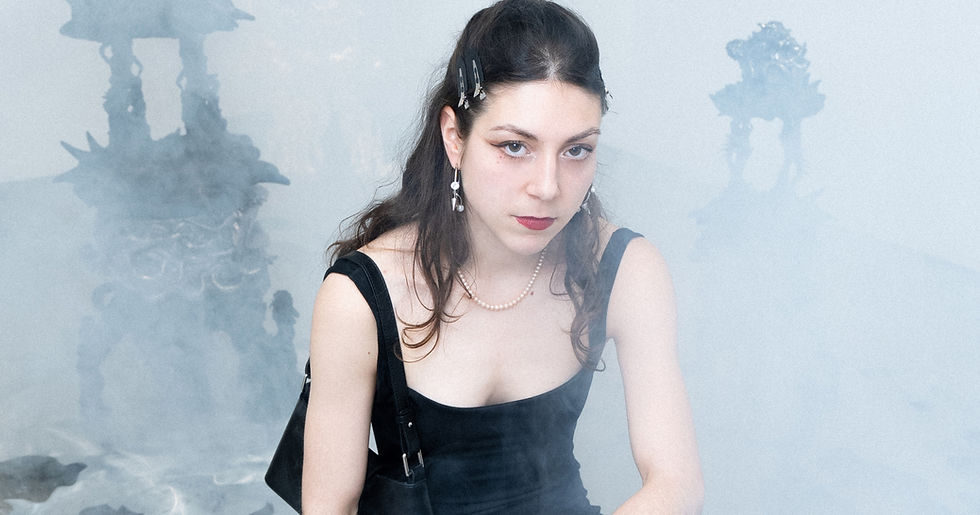
A sentence can be memorialized in many intimate forms. Artist Katie Ubhi, also known by her online handle @griefmother, stitches her emotional vocabulary into fabric, found materials, and carves them into fruit. In her hands, language is given a body to live on, even if ephemerally.
The movement between language and material is fundamental to her practice. Katie isolates selected fragments from various archives she has built over the years, anonymous vintage photographs, digital ephemera, poetry, music, and personal writing. Primarily, she prints and inscribes the words onto vessels that arrive with histories of their own. An ornate handkerchief already indicates the private rituals such as bodily care. A faceless photograph of an anonymous girl that belonged to a life unknown is brought before a current set of eyes. A piece of old fabric with torn edges can also be an evidence of what it once served. The previous lives of all these materials begin to overlap with a new layer.
By its very nature, the emotional register of her text carries significant weight. There is a recurring language of grief, longing, tenderness, nostalgia but also a more unruly layer of desire, anger, morbidity, discomfort, sexuality and refusal. “Am I making you feel sick?”, a haunting and confronting phrase from the song Strangers by Ethel Cain, is sewn delicately on a handkerchief. In another, quoting ingydar by Adrianne Lenker, “you are as far from me as memory” is embroidered on linen in the shape of a rabbit. Song lyrics and literature excerpts make frequent appearances, alongside poetry of her own. What draws them together is their emotional makeup.
1. Katie Ubhi, You are as far from me as memory, words from ingydar by Adrianne Lenker, embroidery on fabric.
2. Katie Ubhi, Everything I feel returns to you somehow, embroidery on fabric.
Not all of her works preserve language though, in some, the embodiment remains unstable. Two photographs record a halved apple carved with the words rotten desire: first, the stamped letters sit clean on a pale flesh, then moments later, the same fruit during oxidization, darkening the letters as its surface changes. In another piece, the word forgetting is assembled from ice letters melting slowly across a wooden table. Here, the materials themselves instrument the language’s impermanence.
It can be said that the artist’s intimate impulse to gather is akin to a contemporary commonplace. Readers in the Renaissance and early modern period would collect passages, quotations, and pieces of knowledge discovered under different subjects. These fragments were taken from their original contexts and collected together in private volumes. Both the functional and the conceptual logic of a commonplace book can be traced today in physical (collages, zines, artist’s book) and digital media (curated Tumblr or Instagram feeds). The content and its carriers migrate, but each technology relies on a ritual of selection and repetition, over time the fragments accumulate a recognisable inner world. Griefmother’s early Tumblr presence fits into this lineage of accumulation, where images and texts are perpetually circulated, reblogged, juxtaposed beside one another. What began during Tumblr’s collective culture continues over her Instagram archive/artist portfolio comprising objects, textiles, prints, and fragments. Her audience of roughly 118,000 followers has become familiar with her artistic expression. The private archive has, in turn, become a shared commonplace, offering a visual/emotional language that can be related and inhabited by the audience.
1. Katie Ubhi, How the absence of someone else feels like the absence of myself, words printed on fabric.
2. Katie Ubhi, I wasn't beautiful anymore, blood soaked fabric with a quote from White Oleander by Janet Fitch.
Her stitching also captures a distinctly collective quality. Historically speaking, embroidery was a communal textile art and practiced among groups of women, worked alongside one another, passed informally between generations through the sharing of skills. In The Subversive Stitch: Embroidery and the Making of the Feminine, Rozsika Parker examines how embroidery constructed an ideal of femininity built around patience, delicacy, discipline, and domesticity. Simultaneously, the same craft had offered women a space to make meaning on their own terms. The argument of the “subversive stitch” lies in this tension of speaking via a medium that was already saturated with expectations on femininity.
Perhaps most revealingly, the delicacy of the material does not necessarily prepare you for the feeling it holds. In My Rabbit Is Dead, we come across a poem Katie wrote for her university degree show, then embroidered in cursive on a vintage silk slip: My rabbit is dead. He’s buried in the garden. The gown is gentle to the touch but the blunt language is far from ornamental. The repeated lines announce the rabbit’s death without attempting to soften the grief, and reads almost like a short eulogy that lingers on the act of naming the loss. Elsewhere, a blood-soaked lace trim borrows a line from Janet Fitch’s White Oleander: “I wasn’t beautiful anymore. Now I looked like what I was, a raw wound.” Parts of the female experience that are difficult to articulate directly, such as desire, grief, shame, anger, longing, morbidity to list a few, become legible through the visual language in contemporary girlhood online, transgressive when called for. Griefmother’s sentiments feel right at home within this vernacular, in which a quiet underbelly of abject, unruly, and at times violent femininity is given shape.
Katie Ubhi, Rabbit poem dress, words stitched on fabric.
Embroidery carries a long historical association with femininity, domesticity, patience, and care. What does that history mean to you as an artist?
As it has always been a feminine practice, for me it feels special to be able to carry on the tradition of it while also consciously presenting it in an artistic context.
I think because embroidery throughout history has continuously been dismissed as important or special due to it being seen as a women's hobby, helping women to learn patience and quiet productivity, I feel empowering in my naming it as artwork, bringing it into the light, front and centre to acknowledge the beauty and care in its practice.
Embroidery demands patience and care, I sew everything by hand and have come to find so much comfort in the repetition of it, in a lot of ways it is an art therapy. I feel joy in its connection to all women who have passed down these skills or generations and honoured to join them in the practice.
Some of your most difficult sentences are rendered in materials conventionally associated with delicacy (silk, lace, handkerchiefs, cursive embroidery). Are you interested in the friction between the physical object and what it is being inquired to say?
Yes, I am definitely interested in the tension between the two. I think the contrast draws more attention to the words, having something difficult said on something so delicate almost forces you to acknowledge it, drawing you in and confronting you.
Since I do often choose words that are sharp, or like you described, difficult, I feel as though putting them against the gentle materials like silk and lace, in a way, makes them more tolerable. A soft background to bring comfort with the uncomfortable, makes it more tolerable.
Katie Ubhi, Apple series, words carved on fruit.
Can you tell us about My Rabbit Is Dead? What brought you to the poem, and what made a vintage silk slip feel like the right surface for those words?
I've had rabbits as pets all throughout my life and so naturally they are my favourite animals. Having them pass away has always been a very sad experience and I've cried every time, though one death particularly stood out to me.
I had a black and white rabbit called Stein who my whole family adored but particularly my mom, he was her baby. I would always watch her from my bedroom window stroking and talking to him for ages, like he could understand. Though he probably couldn't, I do think he must have felt her love. When he died, it was of old age and on Christmas day. He died slow, all day we were outside with him, I think we didn’t want him to be alone. He tried to get himself to stand up but his body was too weak. When his heart finally gave out, seeing my mom's reaction made the experience feel so much more profound, I had never seen her so distraught.
I had loved him and I was sad but watching my mom's experience is what made it so memorable to me. Maybe it's just easier to comprehend someone else's pain rather than your own, but it made everything feel so much bigger that day. I wrote the poem a few years later, for both me and my mom. Since it's a longer poem that I'd usually create for, I wanted a big piece of material to stitch it on, once I came across the slip dress in a vintage shop, I knew it was the one. Like I answered in the previous question, I wanted to soften what was being said by putting it against a soft background. The poem and the piece itself are some of my favourites I've ever done.
Your works sometimes preserve language, while others, i.e. the carved apple or melting ice letters, let the words deteriorate with the material. What draws you to impermanent forms of writing?
Most of the time for my carved apples, I choose words that feel like they belong there, that can rot and disappear with the fruit itself. One of my favourites I've done is, ‘love changes you’. I felt the context of the words and the apple were perfect together; both about change, showing the apple first fresh and juicy and then again, rotting.
Words can hold a memory or a feeling, but both of those things can change or be forgotten. I am drawn to the struggle between wanting to preserve and to keep something all while knowing it can't be held onto forever.
1. Katie Ubhi, Mostly I want to be kind, words engraved on rock. 2. Katie Ubhi, I have dreamt of you so often, words engraved on wood. 3. Katie Ubhi, Lucky to be here, words engraved on leaf.
Your early Tumblr presence emerged within a culture built around cultivating and archiving images and words, which was a formative pastime for many of us growing up online. What did Tumblr teach you about making and looking at art, and what drives that impulse to collect?
Tumblr was very much the beginning of my artist life. Having a blog is often compared to a bedroom wall, collecting images and words, reposting anything that catches your eye or something you want to remember, making it pretty or silly and not having to explain or caption things.
I think Tumblr was so special because there are no public followers or real account statistics. It never became competitive or cool to brag about follows; it was just everyone in their own space, collecting their own things, creating an archived portrait of themselves. There are images of all kinds of art there and its very welcoming to all interests and fandoms.
After being on Tumblr for a few years, my blog was so dull of poetry and images of physical media. It was almost kind of a natural progression for me to start creating my own. I learned of my love of poetry on there and my love of collecting, it's not surprising I became known as a collage artist, always collecting and putting things together.
Do you think the internet has changed what it means to express an intimate feeling publicly? How do you negotiate that transition from the anonymous and private feeling to public image?
Absolutely. I try my best to keep what I make and the words I use as honest to myself as I can, however so much of the time I find myself unintentially watering it down or making it more physically pleasing and digestible to an audience.
I think Instagram and social media in general in recent years have become a much more accepting place for the very honest and the intimate. For me it's becoming easier to create based on my own experiences, making the things I create true, without being completely intimately honest.
1. Katie Ubhi, am I making you feel sick?, words from Strangers by Ethel Cain embroidered on fabric.
2. Katie Ubhi, There is still love here, words engraved on ceramic.
Your works are mostly portable at scale, from handkerchiefs, pieced fabrics to leaves, photographs, and other small objects. Do you imagine your practice expanding into larger or more spatial installations, or is the closeness of scale important to the work?
On one hand the intimacy of smaller pieces is important to my work. It provokes audiences to come closer and look deeper. On the other, I am interested in occupying larger spaces. I think I unintentionally limit myself to a smaller scale a lot of the time because I have a very ADHD brain. I create very quickly because I get bored or distracted very fast. I lose interest in larger pieces after a couple of days, so I’ve always veered towards smaller ideas as they can be finished much quicker.
I would very much like to practice slowing down and keeping focus as I have so many ideas for experimenting with larger pieces. I’d like to figure out making larger pieces while also keeping the feelings of intimacy intact.
Congratulations on your degree! As you enter this next chapter of your practice, what are you most looking forward to in the near future?
Thank you so much! I am really looking forward to moving out of my comfort zone and creating on a larger scale. Deadlines give me a lot of anxiety and shut me down, so having the freedom and opportunity now to create in my own time is very exciting. I’d like to continue experimenting with different feelings and mediums to expand my practice and I'm excited to share whatever comes next!
Katie Ubhi, no men or mirrors, words printed on a vintage handkerchief.
Katie Ubhi, forgetting, photo series of ice letters.