In Conversation: Alina R.J. on the Presence of Healing

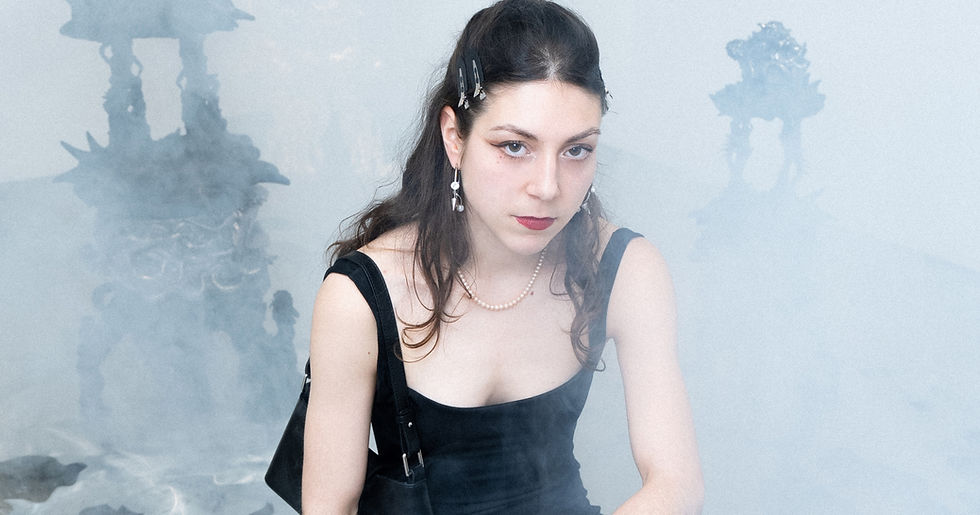
Alina in tusau keser, video performance, 2024. DOP: Ayana Kulbaliyeva. Concept, Creative Direction, Performer: Alina R.J.
Alina R. J. is a London based Kazakh artist, performer and energy healer working across sound, performance, painting and ritual. Growing up within the reach of mountains and an ancestry of mythology, superstition and initiation, she came to inhabit a particular sensitivity to what exists beyond the immediately visible at an early age. That formative sensitivity continues to shape her artistic approach through bodily memory today. Drawing on Jungian individuation, somatic practice and expressive arts therapy as the conceptual ground of her work, Alina’s primary approach to art is a means of reaching forms of knowledge rational thought cannot access alone, in which she explains, is an aptitude the body and psyche inherently hold. Together her use of image, sound, movement and ritual materialize what might otherwise remain outside the capacity of language.
The same inward process finds its equal in the collective. Under her performance collective Angaqquk, Alina stages works that function as shared rituals, where deeply personal symbols are worked through and resonated with the audience. It is in this movement from the internal towards the communal where her art meets much of its strength. Performance, combined with somatic practice, therefore offers a method of inhabiting different states and archetypes and elevates the body both as both the conscious medium and the instrument of healing.
For Alina, sound is central to practising attention, and listening is an active player in remaining duration. Closely influenced by the research American composer Pauline Oliveros has pioneered as Deep Listening, her ongoing sonic archive consists of field recordings from different places, collecting the identifiable sounds of each location, the distances, interruptions, repetitions, silences and barely perceptible shifts that make up an atmosphere. In a city as acoustically congested as London, this attention attunes another significance. To listen with intent is to master the speed at which a place is usually consumed.
In 2025, Alina spent months off-grid in the Arctic Circle Residency in Svalbard. Her experience now anchors her first solo exhibition, a listening room accompanied by a multichannel projection. This June, she also launched House of Umai, an events platform and gathering space named after Umay, the celestial feminine figure in Turkic mythology associated with protection and creation. Hosting twice-monthly workshops that bring mindfulness and creativity into the same space, the project extends Alina's growing interest in participation and shared experience.
untitled (euphemisms for death), video performance during the Arctic Circle Residency in May 2025.
Supported by the Geologists’ Association.
One of the core influences in your art is Jungian individuation, which can be a very solitary process. How do you reconcile that with the collective and participatory nature of your performances?
I feel that the process of creation often becomes, or mirrors, my own process of individuation. There have been so many realisations about myself that I’ve arrived at through making, by taking something that exists internally and giving it a material form. At certain points in that process, it can feel as though you come into direct contact with something larger than yourself. It’s a very magical state to find oneself in.
Although individuation is inherently personal and, in many ways, solitary, I don’t think our inner experiences are ever entirely isolated. As humans, we move through many of the same fundamental experiences in different forms. I’ve often felt this myself when encountering a book, a film, or a work of art that somehow gave shape to a feeling or state I had been experiencing but couldn’t quite articulate. The artist had already found a language for something that I was carrying internally.
I think that is one of the powers of creative practice: we often experience the world with a heightened sensitivity, and sometimes we are able to give form to states that others may also recognise within themselves but have found difficult to pinpoint. I feel it’s important to be generous with those discoveries rather than keeping them entirely private. For me, part of being an artist is creating forms through which these feelings, questions and states can become accessible to others.
This is also where the collective and participatory nature of my performances comes in. The performances we create with my collective Angaqquk are, in many ways, our own rituals: spaces where we process what we are experiencing on an individual yet shared level. They allow us to make something deeply personal together, while also opening it up for an audience to witness.
The works are often emotionally charged and filled with symbolism that carries very specific personal meanings for us. But once the work enters the space and is witnessed by others, those symbols and experiences can begin to resonate beyond their original meaning. Perhaps that is where the solitary process of individuation meets the collective: something begins within the individual, but through art it can become a shared experience.
A lot of practices like meditation and energy work are circulating in highly commodified and Western contexts. Where do you position yourself within that discourse, and how does your Central Asian background shape your perspective on it?
We do live in the age of capitalism, so commodification inevitably becomes its byproduct. I don’t necessarily think that something loses its meaning simply because it has been commodified. For example, if someone engages with a meditation they have paid for, the experience they have with it can still be deeply personal and meaningful.
For me, the bigger issue is when practitioners begin to impose certain ‘poisonous’ beliefs or conditioning onto you and, rather than helping you connect with yourself, only leading you further away from yourself. It can be very tempting, particularly when we feel lost, to look for answers externally and have someone tell us what to do. However, I believe that the deepest source of truth is within each of us. Sometimes we need another person to guide us towards it, to create the conditions in which we can hear our own intuitive wisdom more clearly. But ultimately, in my own energy healing practice, I see my role as holding space and facilitating that process, rather than positioning myself as someone who has the answers.
My Central Asian background had a profound influence on the way I understand spirituality, nature and the unseen. The land and culture I grew up around are deeply spiritual, and filled with superstitions, mythologies, symbolic rituals and forms of initiation that are still nurtured and kept alive. Involuntarily, you become a witness to the divine presence in your day to day and it does inevitably leave its mark. You become more receptive to the sublime and the unseen.
Kazakh culture also has a deep relationship with nature and growing up in such close proximity to the mountains was a pure blessing, which I unfortunately did not appreciate enough until I moved away. Some of my core childhood memories are things like driving for three hours at sunrise into the mountains to find a herbalist somewhere in the middle of nowhere, waiting in an arbitrary queue for her to check your pulse and give you a ‘prescription’. Looking back, I feel deeply grateful for the particular relationship to land and spirituality that it gave me. Those early experiences indeed continue to inform the way I relate to intuition, healing, and to something larger than ourselves.
Documentation from Alina's residency at the Arctic Circle. Courtesy of the artist.
Your practice moves between art-making and healing. Do you see these as fundamentally the same process?
For me, it definitely became one.
Over time, my practice shifted from image-making towards a deeper process of encounters with my own psyche. I’ve been curious about psychology and philosophy from a very young age, mostly because I wanted to understand myself and the world around me on a deeper level.
I would often try to understand a certain pattern or context on a rational level, but there is so much more to express and discover through non-verbal and intuitive means. It literally unlocked another dimension of self-exploration for me.
Performance, especially when combined with somatic practices, became a playground for me to embody different states and archetypes, and to develop a renewed connection to my own body and intuition. Instead of only trying to understand something intellectually, I could experience it physically and allow the body to become another way of knowing.
This is also what drew me towards expressive arts therapy, where the emphasis is on process of creative expression rather than on a particular outcome. You are not necessarily trying to make something ‘good’ or produce a finished artwork; you are allowing something to emerge through the creative process and then paying attention to what it might be revealing. It made me realise that making can be a form of listening: that way of working felt very close to my own artistic practice and to the way I naturally engage with intuition.
This is where the two started to naturally overlap for me, and it has become one of the central questions in my practice: how can creative processes help us access forms of knowledge that already exist within us, but that we may not always be able to reach through rational thinking alone?
What draws you to working with sound as a way of translating place and experience?
Again, I am constantly searching for ways to discover the world from various angles with the whole multitude of perspectives that are available, and I love populating my sensory library of experiences.
Our culture is very visually dominated, and we are exposed to immense amount of visual stimuli on a daily basis. In addition, noise pollution in London is also quite intense, which can make us increasingly desensitised to the way we related to both visual, sonic or any other sensory information. That way, consciously engaging with sound and practising what Pauline Oliveros describes as ‘deep listening’ can become a very meditative way of practising presence. There is something about listening deeply that demands a different kind of attention. It is harder to listen in this way while having another thought process running in the background. Sound can bring me into a more immediate relationship with the present moment.
Overall, any time-based media feels very alluring to me. There is something very intimate in the fact that it desires your full attention or otherwise what you can grasp inevitably becomes incomplete. It creates a different kind of relationship between the work and the person experiencing it.
When I work with field recordings, I’m also interested in how sound can carry the memory and atmosphere of a place. A recording can preserve something very subtle, a particular rhythm, distance, silence or texture, and allow you to return to it later. In this sense, I think of my recordings as building a kind of sonic archive: a collection of moments, places and experiences that can continue to exist and resonate beyond the moment in which they were captured.
tusau keser, video performance, 2024. DOP: Ayana Kulbaliyeva. Concept, Creative Direction, Performer: Alina R.J.
In 2025 you were a part of the Arctic Circle Residency. What did it mean for you to create in a place where human presence feels minimal or temporary?
It was definitely the most surreal experience I’ve had in life: all of these magical sceneries, the sun that never sets, time I’ve spent in solitude disconnected from my usual life in London. Being one on one with nature, just sitting somewhere at the top of the mountain with my field recorder, once again emphasised how much I love it and how grateful I am that I have a chance to experience something like this while also realising my creative potential.
The moment I landed to Svalbard, I actually wrote one of my now favourite poems. I was looking at the landscape and suddenly got something that almost felt like a ‘download’ (I would love to avoid using spiritual jargon but for the lack of better word…). Overall, I felt so much more connected to my intuition there, partly because I took away social media and any notification you are constantly being bombarded with out of the equation. The vastness and monumentality of the landscapes there also deeply amazed me. Especially when you put things into perspective and realise that at this exact second while I am answering these questions, there are glaciers shifting and whales vocalising under water somewhere around the North Pole. Pure magic!
How did your body respond to the conditions of the Arctic while you were making work there?
The experience in a way requires you to be more in tune to your feelings and your physical body, while the sense of novelty invites you to be more present. I specifically wanted to connect deeper with my intuitive wisdom, so I chose to stay offline for the duration of the residency. I also didn’t have a rigid plan for the residency since I wanted my intuition to guide me, and it did. I purchased some red roses and matches in Svalbard just an hour before we sailed, without really knowing what I was going to do with them. I later used them in my video essays, and I’m very pleased with the results. I think this was a good example of how I wanted to work there: to stay open, follow an impulse, and trust that the meaning would reveal itself through the process of making.
loveletters, performance with Angaqquk Collective at Dangerous Kitchen, London, UK, 15th Feb, 2024.
Performers: Alina R.J, Kristina Baeva. Choreography: Kristina Baeva. Sound & Set Design: Alina R.J
What are you currently outgrowing in your own way of working? And, where do you see your practice evolving next?
Lately, I’ve been finding lots of joy in doing simple intuitive drawings in the morning, sometimes accompanied by writing. When painting, I would normally start on a bigger scale, but I feel like sometimes I can start self-sabotaging myself and avoid painting altogether because the scale feels too intimidating and too time-consuming. I’m learning that finding small outlets for creativity that can organically fit alongside everything else that is going on in life can still allow you to show up for your practice.
I’m also currently investing a lot of my time and energy into participatory events, listening sessions, guided meditations and creativity workshops that I host. I’ve always loved connecting with people and holding space for these kinds of gatherings brings me so much fulfillment. I think this is also where I see my practice evolving: towards creating more opportunities for connection and shared experience, where art can become not only something to look at, but something to participate in and experience together.
What would you like to see more of in the London art scene?
I feel like London’s art scene always finds a way to surprise you, especially with its richness of underground and experimental art events. I’m always deeply inspired by talented sound artists, so I’m particularly keen to discover more listening spaces and places dedicated to experiencing sound collectively.
If we’re talking more about the ‘insider’ side of the art world, I would genuinely love to see a better structure around financial compensation for artists working with less traditional and commercial mediums. Performance and sound art, in particular, could definitely benefit from more public or private funding. So much of this work is time-intensive and requires a huge amount of labour, yet it can be difficult to find sustainable financial structures around it. I’d love to see more recognition of the value of these practices and better support for the artists who are building them.
Can you tell us about the projects you are excited about for the rest of 2026?
This June, I launched House of Umai, a very personal project that took me around three years to come to life in the form that feels right. I see it as both an events platform and a gathering space.
The name is inspired by Umay, a celestial feminine figure in Turkic mythology, associated with fertility, protection, nurturing and life-giving force of creation. I wanted the project to carry something of that symbolism: a space that feels nurturing, creative and connected to a deeper sense of self.
I’m now hosting workshops twice a month, bringing mindfulness and creativity together, both of which are very dear to my heart. The intention is to create an environment for anyone who feels like they are carrying a lot of potential that is yet to be materialised, are going through a period of transition, or simply want to learn tools for working with their energetic field, becoming more magnetic to the right opportunities, and developing a deeper relationship with their own inner landscape.
Alongside this, I’m also working on my first solo show, where I’ll finally be able to present the work I developed during my residency in the Arctic. The conceptual side of the project is now ready, taking the form of a listening room alongside a multichannel projection — we just need to find the right space for it. I’m really excited to share this project with the world and see it finally coming to life.
Courtesy of the artist.