Yaz Taşçı at Alo Galerie: On Migration, Solitude, and the Politics of Touch
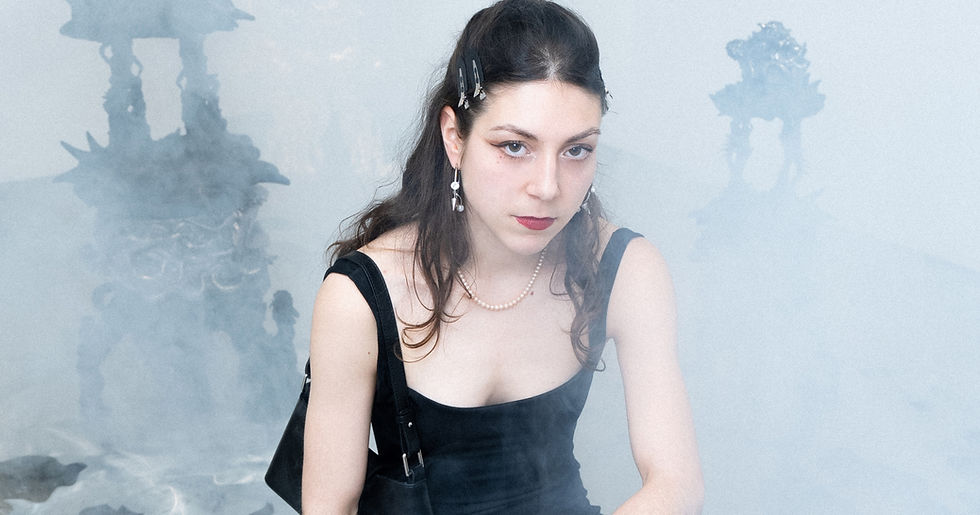
Yaz Taşçı in Paris, 2026. Photography: Umut Sur.
Darkness, as a place, conceals and facilitates Yaz Taşçı's figures to be heard, felt, and consequently known to one another in manners that daylight may restrict. Taşçı’s women have stayed constant in these undefined, nocturnal intervals. Their suspension in the dark reads less as flight as the nighttime can bear possibilities in which the self can loosen its grip on visibility. In the night, the silence sharpens, and guides further the small sounds or gestures that are present. Yaz Taşçı, A Paris-based artist from Turkey, traces the emotional terrain of intimacy and connectivity in her works. A few years ago, when Yaz moved to France, her migration had brought her a time full of uncertainty, solitude, and alongside the cultural integration, a slow and demanding willpower towards learning a new way to exist.
Evidently, this shift has altered her work as much as her personal life. Although figuration has stayed constant throughout her career, Yaz has recently incorporated the questions of what it means to put down roots in a place that is hard-won, or that has not fully claimed you as a part of it yet. Comparably, the subjects of her Istanbul paintings would be dense in numbers, sometimes containing a hundred bodies. Upon her arrival in Paris, though, the crowds have gradually thinned out. Compositions narrowed to less than a handful of figures, lining up with how, as you start life over in an unfamiliar city, the social circle may shrink smaller as well. Despite this transformation, solidarity has not disappeared from her work so much as changed shape. What was previously collective action has evolved into her current explorations of the quieter, visibly wearier beings. However, despite the trying circumstances, the figures continue on retaining the intimate and close liaison that has occupied a crucial part in Yaz’s artistic practice; a condition she describes as bodies asserting, through touch, that they haven't yet forsaken hope.
In her interview with Plasma, Yaz Taşçı talked to us about her decision to read women as icons or figures of strength rather than subjects muted down to systemic self-victimhood. Similarly, the same pull towards human connectedness and shared experience was embodied in her recent exhibition at Alo Galerie in Paris, alo, yaz taşçı?, presented from July 16–30, 2026. For two weeks at Alo, Yaz turned the Parisian gallery to her production studio, painting in full view of walk-ins and visitors, open to observations, lingerings, and embraced intrusions. The exhibition format, which was celebrated with a finissage in place of a traditional opening night, complemented the present philosophy that a painting does not need total privacy, nor the perfect conditions in order to attain its own existence.
Yaz Taşçı, Le mouvement de l'instant II, 2026, oil on canvas, 80 x 163 cm. Courtesy of the artist.
Could you give us a background on how you moved to Paris?
Toward the end of my time in Turkey, I had reached a point where I felt completely exhausted. It had become difficult to breathe, both literally and emotionally, and I was desperately looking for a way out. At that stage, I was considering every possible option, even seeking asylum somewhere and trying to build a new life abroad. I was consumed by the idea of leaving. What I never imagined was that art would become my way out. I'm only a high school graduate. Although I was accepted into Marmara University, I never pursued an academic career, and without that background it's incredibly difficult to establish yourself internationally as an artist.
Then I learned about Artists at Risk / Artist In Exile, a residency program for artists who cannot safely or freely continue their practice in their home countries. Artists from all over the world are nominated, and I was fortunate to be recommended by a friend. Of course, I already knew the Cité. Many artist friends had completed residencies there, but I had never seriously imagined it for myself.
What makes the story even stranger is that, at the time, I had almost decided to seek asylum in Switzerland. My friends and I were saying goodbye as if I were leaving forever. We spent our nights drinking rakı, crying, and preparing for that kind of departure. Instead, I suddenly arrived in the middle of Paris with an artist's visa, living and working in a beautiful two-story studio. Our cohort included eight artists from countries such as Sudan, Iran, and Ukraine. They were all remarkable artists, each carrying their own story of displacement.
How has changing countries shaped you personally?
I don't really think of it as changing cities. For me, it was much closer to a migration experience. When I moved from Istanbul to Paris, I wasn't thinking of it as spending a year abroad on an artist residency before returning home. It felt like leaving one life behind and asking myself, How can I exist somewhere else?
That transition came with enormous uncertainty, fear, anxiety and vulnerability. I didn't speak English, and French had never even crossed my mind as a language I would one day have to learn. I had absolutely no idea what my life would look like after I arrived. I still remember the feeling I had as I left the airport in Turkey. That was the moment I realised this wasn't simply travelling somewhere new– it was accepting that I was becoming a migrant.
Before I moved, my mentor Mathieu explained that the residency's priority wasn't for me to produce work, but to integrate into French society, learn the language and build a life there. I remember apologising to him and saying, "I'm sorry, but I'm going to paint." And I did. I painted constantly. Looking back, I realise that painting became the way I survived those first months. In many ways, it was the thing that kept me alive.
Exhibition views, "alo, yaz taşçı?", Alo Galerie, Paris, 2026. Photography: Umut Sur.
In what ways has your migration influenced your work?
Migration changed my work in a very visible way. If I look back at the drawings I made six or seven years ago, they were incredibly crowded. Some compositions contained fifty, sixty, even a hundred figures. But after moving to Paris, I realised something. When you're alone in a new city, the number of people you can physically reach out to becomes very small. There are only a handful of people you can truly touch, trust, or feel close to. That reality entered my paintings. The number of figures gradually decreased. The loneliness of the city, the fragility of new relationships, and the feeling that friendships can never quite resemble the ones you left behind; all of these became central to my work. I found myself thinking more about closeness, human connection, facial expressions, and what a simple touch can mean. I became fascinated by how much emotional weight a gesture can carry. For a long time I was genuinely alone. Even now, I'm not sure I've fully built a community.
I also come from a background of activism. I know what collective struggle feels like and how powerful solidarity can be. There was a period when that sense of collective action was the central subject of my paintings. Now, another experience has entered the work: learning how to exist alone, and discovering that solitude can also become a meaningful, even valuable, space. You can see that shift slowly making its way into my paintings.
Your recent paintings move from large collective scenes to much smaller, more intimate encounters. What prompted that shift?
In recent works, the girls in my paintings are usually together in pairs, or sometimes groups of three. There's a sense of exhaustion present. We get tired. Activists get tired. There comes a point where people begin to let go. Not because the struggles they cared about no longer matter, but because they've spent so much of themselves fighting for them. There's a kind of burnout, a quiet hopelessness, that slowly settles in. When I look at my paintings, the way these girls reach for one another or try to create moments of intimacy feels like an act of persistence. It's almost as if they're saying, "We're still here. We haven't given up." Those gestures of touch become a way of making that determination visible.
What has always fascinated me, though, is not only collectivity itself but the atmosphere that emerges between bodies. I'm almost obsessive about observing gestures and trying to understand what they communicate. I'm interested in the emotions, tensions and meanings that arise when people, or even objects, share a space. The sounds we make, the way we look at one another, the feelings that emerge from those moments: these are things I think about constantly. Painting becomes a way of paying attention to those moments.
There is a passage in a book I love that suddenly comes to mind: “Whenever wonders are created in embroidery or painting, whenever a beauty appears in a workshop that brings tears to my eyes and sends shivers through me, I know that it is because two separate things that had never before come together have united and created a new wonder.”
Yaz Taşçı, Le cygne qui vole des couteaux, 2026, oil on canvas, 65 x 81 cm;
Yaz Taşçı, Untitled, 2026, oil on canvas, 60 x 60 cm. Photography: Umut Sur.
What would you say becomes possible in the darkness contrary to the daylight?
I think what darkness offers us is silence. Silence allows me to hear more clearly the things I want to hear. In the quiet of the night, even the smallest sound becomes more noticeable. I also think of this metaphorically. Night feels like a space where simplification becomes possible, where intimacy can be built more easily, and emotions become easier to understand. For me, darkness is a place where existing feels a little easier. It allows you to hide what you want to hide, to see what you want to see, or even to disappear for a while if that's what you need. In that sense, the night offers us the possibility of being heard. My figures seem to be searching for somewhere they can truly belong, but they haven't quite found it yet.
I actually don't consider them spaces at all. I think of them as voids. My girls are often suspended in an undefined place. Their feet almost never fully touch the ground because, in my mind, I'm still not sure whether that place actually exists. Having your feet firmly on the ground can closely be connected to belonging. Lately I've been trying, little by little, to introduce actual spaces into my paintings. I think that's because I also have a growing desire to belong somewhere. Now that I've received a four-year residence permit, there are moments when I catch myself thinking, Maybe I do belong here.
That makes me wonder whether these girls can finally begin to inhabit a place. And not just the girls. What happens when other objects or other living beings enter that space? How does that change the emotional atmosphere of the painting? These are the questions I'm slowly experimenting with. Recently I painted strange shrimp-headed creatures that first appeared in one of my dreams. They feel almost invasive, as though they're trying to occupy or plunder the space I'm attempting to make my own. Because when you finally begin to feel that somewhere belongs to you, there's always the possibility that it can be taken away.
Is that perhaps a fear of losing?
I think it's slightly different. That feeling comes from not being given security or the confidence that you're genuinely welcome somewhere. Of course, there are many reasons why someone might struggle to feel they belong. But for me, it's more about trying to root yourself in a place that has never fully embraced you. It's about not feeling safe enough to settle, to put down roots. That uncertainty creates anxiety. It fills your mind with questions and makes it difficult to ever feel fully at ease.
Why has figurative painting remained central to your practice?
I think what has shaped my practice most isn't simply the tradition of figurative painting, but my experience of collective organising. Activism gave me a sense of responsibility. I wanted painting to stand for something and to represent strong women. A friend once told me, "I've never seen a victim in your paintings. Whenever I look at your work, I only see powerful figures." I loved hearing that, because that's exactly what I wanted. I wanted these figures to become icons– images of strength that people could recognise themselves in. That's why I've continued painting figures ever since.

Exhibition view, "alo, yaz taşçı?", Alo Galerie, Paris, 2026. Photography: Umut Sur.
Memory, desire, transformation, and becoming recur throughout your work. Which of these feels most vital to you right now?
Actually, what has interested me most is what remains after an action; the emotional residue that lingers once a moment has passed. I'm fascinated by how we continue to carry those experiences within ourselves, how we observe them afterwards and recognise their echoes.
I also find myself thinking about why certain actions happen in the first place. In some ways, it's almost psychological. I spend a lot of time wondering what these moments mean for us, what causes them, and how they continue to shape us long after they've ended. I've always had a strange obsession with the meanings carried by gestures.
Lately, I've also begun to think of painting itself as something ritualistic. Making a painting has become a way of returning to moments that remain in my memory and working through them. In that sense, painting isn't only about representing an experience; it's also a way of processing it.
Turning the gallery into a working studio open to visitors changes the usual privacy of the creative process. How has the presence of people affected the way you paint or think during these two weeks?
This format was new for me. At the Cité internationale des arts my studio door was almost always open. People came and went all the time, so I was already used to sharing my workspace. But working continuously in a public setting like this is something different. Interestingly, during the two years I spent at the residency, I never organised an open studio, even though they're very common there. I never really felt the need. My door was already open.
As for the painting itself, if a painting is meant to exist, it somehow finds its own way of appearing, and I become its vehicle. Because of that, I don't think paintings require perfect conditions. I'm also not very interested in the romantic mythology that sometimes surrounds the figure of the artist. If someone needs to paint, they'll paint wherever they are. I actually enjoy painting while my friends are talking nearby. Most of the time I'm not even listening to the conversation, but I like the presence of people around me. Within three days I had already completed three paintings. I hadn't planned them or overthought them, they simply arrived because they were ready to exist. From that point on, the entire process became something I genuinely enjoyed.
Privacy is a much more complicated subject than we usually assume. I think it's also shaped by class. Some people don't really have privacy because they were never given the space or the right to have it in the first place. Because of that, privacy has never occupied a particularly central place in my practice. Of course there are parts of myself that I protect, but I've never believed that painting is something I can only do in complete isolation.
The project concludes with a closing gathering rather than a traditional exhibition opening. How do you imagine the works being presented on the final day?
We're creating a beautiful table. There will be candles, flowers, figs, grapes and music– a simple, intimate, romantic atmosphere. Most of the paintings I've made here revolve around the table itself. But the works themselves aren't really the centre of the evening. What matters most to me is the conversation. I love celebrating, cooking, drinking and gathering around a table.
More than the food or the occasion itself, I value what that way of being together makes possible. I think there's something deeply meaningful about sharing time, stories and attention in that way. Whenever there's an opportunity, I want people to gather around the table, regardless of the paintings. That's what I hope this project becomes: not an opening or a closing, but a table where conversations happen surrounding people.