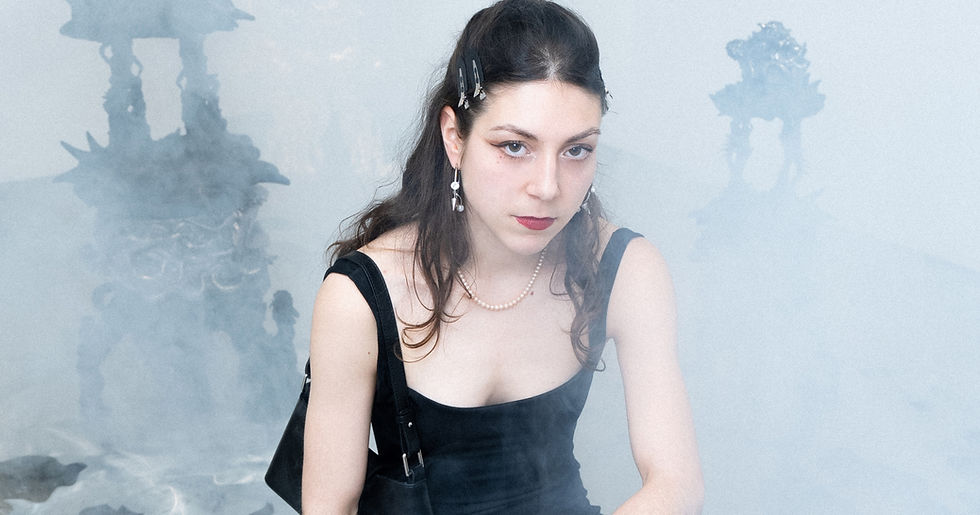
In Conversation with Alo Galerie, Paris 11e
Ayşe Naz Bayam and Derin Demircioğlu, 2025. © Umut Sur.
Last month, we had the absolute pleasure of sitting down with the founders of Alo Galerie for a conversation in Paris– marking Plasma Contemporary’s first in-person, on-the-ground interview.
Founded by Ayşe Naz Bayam and Derin Demircioğlu, Alo Galerie opened its doors in September 2025 in the 11th arrondissement. Located between Rue de Charonne and Place Voltaire, Alo is an independent gallery working with a global generation of emerging artists alongside a philosophy rooted in building lasting relationships between professionals, the public, and institutions.
Ayşe and Derin are closely involved in every stage of the gallery’s logistics, from renovations and installations to artist relations, production, communications, and sales. Their hands-on approach carries through a programme that brings together a range of artistic practices and narratives. A big part of their vision is accessibility, especially for younger and first-time collectors. For Ayşe Naz and Derin, creating an open and approachable space means lowering the barriers for those just beginning to explore the art world.
Our conversation took place during the gallery’s first solo exhibition dedicated to a Turkish artist, Hayri Şengün, accompanied by an exhibition text written by Tess Mazuet. Across sculpture and works on paper, Şengün’s practice explores materiality, gesture, and the intuitive relationship between the artist and his pieces. The characteristics of his practice are particularly visible in the palm-sized brass sculptures, whose surfaces wear the residues of touch and gradual oxidation. Once his physical intervention is complete, Şengün allows time to continue shaping the material, extending the process of transformation beyond the artist’s hand and making chemical and environmental processes an integral part of the work.
During our meet-up, Plasma Contemporary asked Ayşe Naz and Derin about the beginnings of Alo Galerie, their approach in work as a duo, the realities of opening an independent space in Paris, and what it means to build a gallery programme in the current moment.

Exhibition view, Zone Ombilicale, Diane Ségard, Alo Galerie, Paris, 2026. © Bellise Perrin.
What is the story behind the name Alo Galerie?
Derin: We wanted a name that could exist across different languages. In Turkish, alo is what you say when answering the telephone, and the same expression exists in French, although it is written slightly differently.
We liked that it was a familiar and accessible word, something that could be understood by people from different places. There was also something playful about the idea of Alo Galerie almost functioning as a hotline for art.
We wanted the gallery to have that sense of openness and accessibility, but also to leave room for humour and playfulness.
Can you share a bit about your backgrounds and how your friendship evolved into creating this gallerist duo?
Ayşe Naz: We met on the very first day of our bachelor’s degree at the Sorbonne. We became friends and studied together for three years before pursuing different master’s degrees, but we always stayed close.
We had always talked about opening a gallery together, although we imagined it as a distant project, something we might do after working in institutions or galleries for 10 or 20 years. We thought that perhaps, when we were older, we would finally open our own space.
But just after finishing our master’s degrees, while we were both looking for jobs, we asked ourselves: why not now? We were young, we had the energy and the time, and we felt we could afford to try. That was really the beginning of the gallery project. It took us around a year and a half to develop every aspect of the gallery, from finding the space to shaping the artistic programme.
People often assume that we are primarily colleagues or business partners, but we were best friends long before opening the gallery, and we still are. Of course, working with your best friend has both positive and challenging sides. I think we are sometimes almost too nice to each other, which can make certain decisions more difficult. But our friendship and the gallery have become very intertwined. We spend our days working together here, but we also travel together, go on holiday together and visit museums together. The gallery has naturally become another part of our friendship.
Derin: From the beginning, we agreed that we also needed to maintain some separation between work and our friendship. The two are always connected, and that can be a very positive thing, but sometimes you need boundaries. For example, if we see each other on a Sunday or spend time together outside the gallery, we try not to talk about work. Finding that balance can be difficult, but it’s important.
1) Alo Galerie Paris © Bellise Perrin. 2) Alo Galerie Paris © Umut Sur.
Did you initially consider starting as a temporary or nomadic gallery, as many younger galleries do today?
Derin: We considered being nomadic at first, but it was never really our objective. We knew that we wanted a physical space and a permanent address that people could associate with our projects. So, quite early on, we decided to open a space and establish a physical presence in Paris.
To lay the foundations a little further, could you tell us more about your individual academic and professional backgrounds, and how they led you to where you are today?
Derin: We both studied Visual Arts for our bachelor’s degrees. I then completed a second bachelor’s degree in Arts and Cultural Management before continuing with a master’s focused on Artistic Project and Event Management. In the second year of my master’s, I also specialised in Curatorial Studies.
My career began with a more artistic background but gradually became increasingly focused on curatorial projects. I mainly worked in art centres and associative spaces, while also developing my own curatorial practice.
Alongside the gallery, I’m still part of a small curatorial collective called BOUCAN. There are three curators in the collective, and together we develop projects, including a small residency programme.
Ayşe Naz: As Derin mentioned, we completed the same bachelor’s degree in Visual Arts. During that time, I also began working with Siyah Beyaz Gallery in Ankara, one of the oldest contemporary art galleries in Turkey. That experience allowed me to see another side of the art world, which I found much more interesting for myself. I gradually put my own artistic practice aside and became more involved in the gallery side of the field.
I was already living in Paris when I began working with Siyah Beyaz. I initially interned with the gallery and we stayed in contact afterwards. I continued working with them remotely and became involved in their international projects, attending the art fairs they participated in and working on applications and submissions. Later, I completed a master’s degree in Contemporary Creation at the Sorbonne before we opened the gallery. So, professionally, my experience has always been more gallery-oriented.
Derin: Whereas my background consists more around art centres and non-profit spaces. In that sense, our experiences complement each other quite well.
Ayşe Naz: It’s also a balance between profit and non-profit experience, which is reflected in how we divide responsibilities at the gallery. I focus more on public relations and sales, while Derin works more closely on production and administration. That division has naturally become part of how we collaborate.

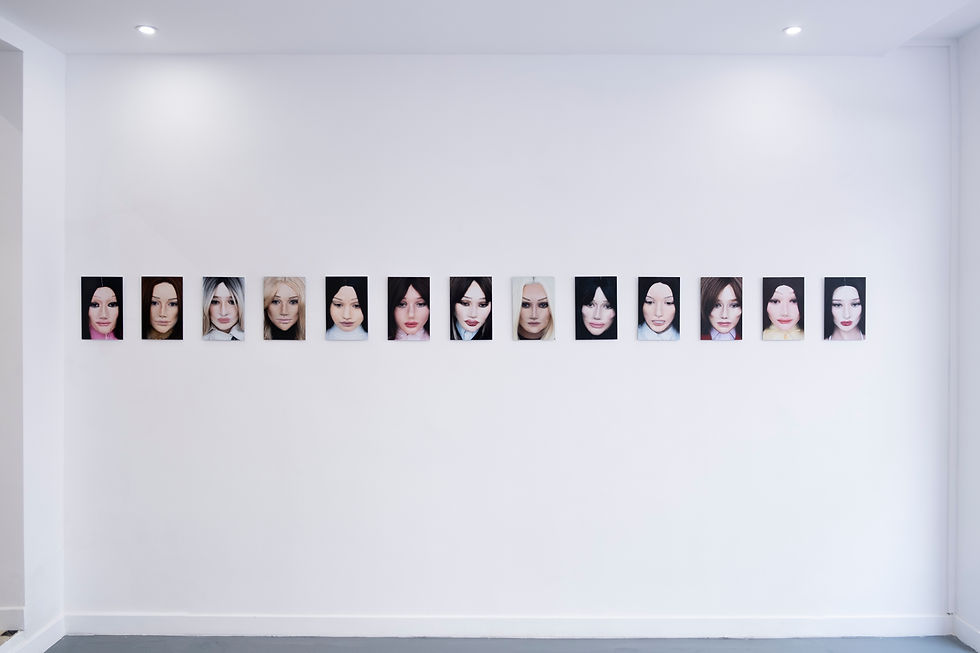
Exhibition view, Poupée de Peau, Noémie Ninot, Alo Galerie, Paris, 2026. © Bellise Perrin.
How do you extend engagement beyond the exhibition space, whether through publishing, public programming, digital platforms or participation in art fairs?
Derin: The gallery is still very new, so there is a lot of room for us to grow in terms of expanding our presence beyond the physical space. Publishing is one of the directions we are particularly interested in exploring.
We haven’t yet published an edition ourselves as a gallery, but many of the artists we have worked with have brought book ideas and publishing proposals into their projects. With the Yoann Bac exhibition, for example, we presented Membrane, a publication that brings together his inspirations around SFX magazine, alongside a selection of his works and an accompanying text by Armand Camphuis.
For our current exhibition, Hayri Şengün has also published 4000 Yesterdays, which brings together his work from 2011 to the present. The book was produced by Nom Atölye, a bookbinding and publishing studio based in Ankara.
We are very open to these kinds of collaborations, and developing our own publications together with artists is something we are actively considering for the future.
Ayşe Naz: Right now, the gallery itself remains our priority. We have only been open for nine months, so we are still exploring the possibilities of the space and discovering what we can do with it. At the same time, we are interested in participating in art fairs because they offer opportunities to meet different audiences and introduce the gallery’s programme beyond our immediate context.
Derin: Collaborations and events are also an important part of this. We’ve already organised several smaller events and collaborative projects, and we enjoy working with people who bring different communities and audiences into the gallery.
Having a physical space in Paris is something we consider very valuable. So, for us, expanding beyond the gallery doesn’t necessarily mean moving away from the space. It can also mean opening it up: creating opportunities for other people and using the gallery as a place where different audiences can come together.
Since the gallery has been open for less than a year, how have you approached building a public around the space?
Derin: I think it happened quite naturally. As soon as we started the construction and renovation work, people who lived or worked on the street began stopping by and asking what we were going to do with the space and when we would open. So, even before the gallery officially opened, there was already a sense of connection with the neighbourhood.
That relationship has continued. Many of our neighbours come to see each exhibition, which is something we really appreciate. In that sense, it’s nice to be located in a part of Paris that isn’t particularly tourist-oriented. There is a strong local presence here.
Ayşe Naz: At the same time, each project brings a new public through the artists themselves, so the audience shifts depending on the artist and the nature of the work. People are drawn to different practices and different types of art, which brings a change to the public while gradually accumulating over time.
Derin: We have also both been living in France for around nine years. Through studying and working in the field, we naturally built a community around us. Many of our friends and former teachers are artists or work within the art world, so there was already an existing network that has continued to grow around the gallery.
Have you encountered structural inequalities or particular difficulties while working within the Paris art ecosystem?
Ayşe Naz: There is a lot that could be said about inequality in the field. We are two young women and two foreigners, so of course we have encountered inequalities within the art world.
Derin: Even when it comes to technical or bureaucratic processes, there are still many steps that need to be taken to create more equitable conditions.
Ayşe Naz: It isn’t easy, but I also don’t think this is something people are unaware of. These inequalities are quite visible within the field. This is also why we are increasingly seeing collectives, creative duos and independent spaces that actively support young and emerging artists, women artists, queer artists.
Exhibition view, Evolution Inattendue, Hayri Şengün, Alo Galerie, Paris, 2026. © Bellise Perrin.
More broadly, what do you think is missing from the Paris art scene at this moment, and what would you like to contribute to it?
Derin: I think the art world, particularly the galleries, is currently going through a period of significant change. Established galleries are closing while new ones are emerging, and similar shifts are taking place among artists and collectors. Everything is in a moment of transition, which also makes this a difficult period for both galleries and artists. The broader political context plays a role in this as well.
At the same time, I think some of the more traditional structures of the French gallery system are becoming outdated, even though they continue to receive significant institutional and collector support. New ways of working are emerging.
For us, this is connected to our decision to work primarily with emerging artists. Supporting an emerging practice can involve a degree of risk that more established galleries are not always willing to take. We are passionate about the emerging scene, and because we are also an emerging gallery, the idea is that we can grow with the artists we work with. We want to build something together.
Being from Turkey while living and working in France also naturally shapes the gallery’s programme. There is an element of cultural exchange in what we do. We are drawn to artists working in Turkey, but also to artists in France, where we studied and have built our lives and professional practices.
We want these different contexts to meet and coexist within the same space. Part of our aim is to create new visibility and opportunities for Turkish artists in France, while also developing possibilities in the other direction. There is potential and energy in both scenes, we are interested in creating connections between them.
We’d like to talk about Hayri Şengün’s solo exhibition, the first solo presentation of a Turkish artist at the gallery. Could you tell us about how the exhibition developed, your relationship with him and the premise behind the show?
Ayşe Naz: This exhibition is actually an exception for us because we are not its curators. Until now, Derin and I have developed the curation and scenography of our solo exhibitions ourselves, always in close collaboration with the artist.
For this exhibition, we worked with Evrim Karacan, an exhibition designer based in Turkey. She developed the exhibition design and has also known Hayri and his practice for many years, so it was very much her project as well. The exhibition was accompanied by a text written by Tess Mazuet, which complemented the curatorial perspective to Hayri’s practice. I have also known Hayri for years, and we included some of his work in our first group exhibition at the gallery. Our relationship with his practice has therefore developed over time.
Hayri refers to these small-scale works as “palm sculptures.” Their tactile quality is very important to his practice, both in terms of the material itself and the experience of the sculpture. We have additional sculptures available for visitors to hold and interact with, allowing them to experience the works more closely rather than encountering them only visually.
Derin: The exhibition is titled Évolution inattendue, or Unexpected Evolution. The central idea relates to the evolution of both form and material.
Some of the sculptures undergo a particular patination process, a form of oxidation that would normally develop gradually over time. Through Hayri’s own chemical processes and techniques, this transformation is accelerated. Yet even after this process, the brass sculptures continue to change and respond to their environment.
When you hold one of the works, for example, it warms in your hand and responds to touch. There is a sense that the material continues to live and evolve.
Ayşe Naz: It is a very tactile experience, both in encountering the sculptures and in understanding how they are made. We regularly visit the artists’ studios while developing exhibitions, so we are able to follow the evolution and progress of the work throughout the process.
We had been visiting Hayri’s studio for months before the exhibition and were able to see how the forms developed, as well as his different experiments with patination. Following that process closely became an important part of our own relationship with the exhibition.

Exhibition view, Membrane, Yoann Bac, Alo Galerie, Paris, 2025. © Bellise Perrin.

Exhibition view, Evolution Inattendue, Hayri Şengün, Alo Galerie, Paris, 2026. © Bellise Perrin.
What aspects of running a gallery and producing an exhibition do you think are most underestimated by those outside the field?
Is it the logistics, funding, installation or the relationships involved?
Derin: I think it’s everything. When you visit an exhibition, you encounter the finished result. If you don’t work in the field, it can be difficult to imagine how many people have contributed to it or how much time has gone into making it happen.
There are so many different aspects involved in producing an exhibition, and there are only two of us. We do everything from the technical installation of the show to accounting, administration and artist contracts. We visit studios, follow every stage of the exhibition’s development, write press releases, manage communications and work on the graphic design. We often say that we are an army of two.
We also relate strongly to the term travailleuse de l’art– an art worker. For me, the term acknowledges the amount of hidden labour carried out by cultural workers across the field. Roles are not always clearly separated or specialised, especially within smaller organisations. Everyone has to do a bit of everything. You are constantly multitasking and managing many things simultaneously, and much of that labour remains invisible. It is also often underpaid and underfunded.
Ayşe Naz: And underestimated. Unless you spend time working inside a gallery or an art space, it is difficult to fully understand everything that happens behind the scenes. It isn’t simply a matter of answering emails, selecting an artist, installing their work, taking photographs and making a social media post.
Derin: Not at all. You have to find funding, identify and build relationships with artists, organise production and manage all the different stages that allow an exhibition to happen in the first place.
Ayşe Naz: There’s also the physical part, we do all of the installation and de-installation ourselves. We even worked on the construction of the gallery ourselves. We were involved in everything, including the exterior of the space.
There has been a lot of discussion around a new generation of collectors entering the art market. From your experience, are you seeing a genuine increase in younger collectors, and how do they approach buying art? Are their decisions driven more by research, emotion or investment?
Ayşe Naz: From our experience, I think younger collectors tend to make more emotionally driven decisions. As we mentioned earlier, the collector landscape is also changing. I don’t necessarily want to say that one generation is simply leaving and another is replacing it, but there is clearly a transition happening, and approaches to collecting are changing with it.
Traditionally, there has perhaps been a stronger emphasis on art as an investment, regarding thinking about where an artist’s career might go and how the value of their work could develop. With many younger collectors we meet, the starting point is often much more immediate. They connect with a work, they love it and then they consider buying it.
Our own approach as a gallery is centred around accessibility. That applies to the physical space, but also to pricing. Within each exhibition, we try to offer works at different price points so that younger or first-time collectors have an opportunity to begin collecting and enter this world without feeling intimidated.
Galleries can be intimidating spaces. Even asking for the price of a work or starting a conversation about buying art can feel uncomfortable if you have never done it before. We want to reduce that distance.
I think this is also why we connect naturally with younger collectors. Our vision and theirs often align. They are interested in emerging practices and willing to support artists whose careers are still developing. A more established collector might enjoy encountering this kind of work without necessarily considering a purchase, whereas younger collectors can sometimes be more willing to engage with and invest in an emerging practice.
1) Exhibition view, Down to Earth, Michael Fanta, Alo Galerie, Paris, 2026. © Bellise Perrin. 2) Exhibition view, Poupée de Peau, Noémie Ninot, Alo Galerie, Paris, 2026. © Bellise Perrin.
What are your plans for the rest of the summer, and what comes next for Alo Galerie?
Derin: After the current exhibition ends on July 4th, the gallery will host a pop-up exhibition produced by an independent curator. Following that, we will present a small, experimental project with Yaz Taşçı. She will produce work inside the gallery, and the project will conclude with a convivial gathering and finissage.
Ayşe Naz: It will function almost like a short, in-situ residency. The gallery will become Yaz’s studio for two weeks, during which she will produce her work here. At the end, we’ll bring everyone together for a dinner or finissage. We’ll be closed in August, and from September onwards, the programme is already full. We’re now working on 2027 and are very excited about the exhibitions to come.
As a final question, how do you define success? Is there a particular goal or measure of success that you are working towards?
Ayşe Naz: I think we might be thinking about the future differently now than we did before opening the gallery. Opening this space was already such a significant step for us. Having the gallery and being here every day was a goal in itself, so now every smaller goal we set becomes part of what we are building. We don’t necessarily think in terms of one artist we need to exhibit or one specific milestone we have to reach.
Derin: We are trying to maintain and develop what we started. I think starting in itself was already a form of success. For me, the courage to begin and take the risk is the success. What happens afterwards is unpredictable. You can start something and fail, or it can continue for 50 years, or just a few. But taking the decision to begin is already meaningful.
Ayşe Naz: Opening a gallery at 25 was a huge risk for us. Either way, we consider making the leap to open the gallery a success in itself.
☏ Check out Alo Galerie on socials: ☏
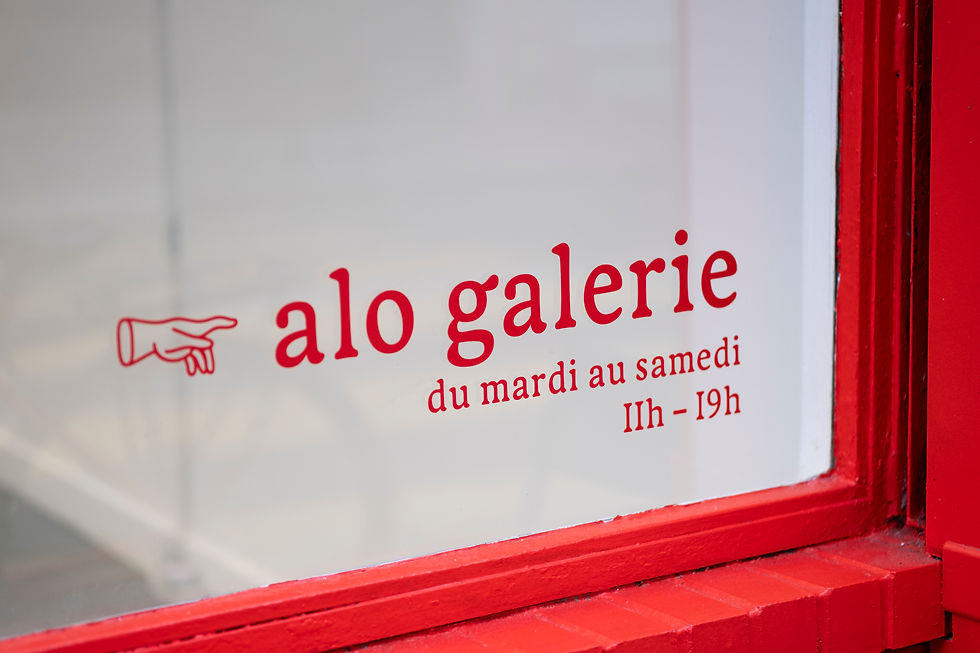
Alo Galerie Paris © Bellise Perrin.
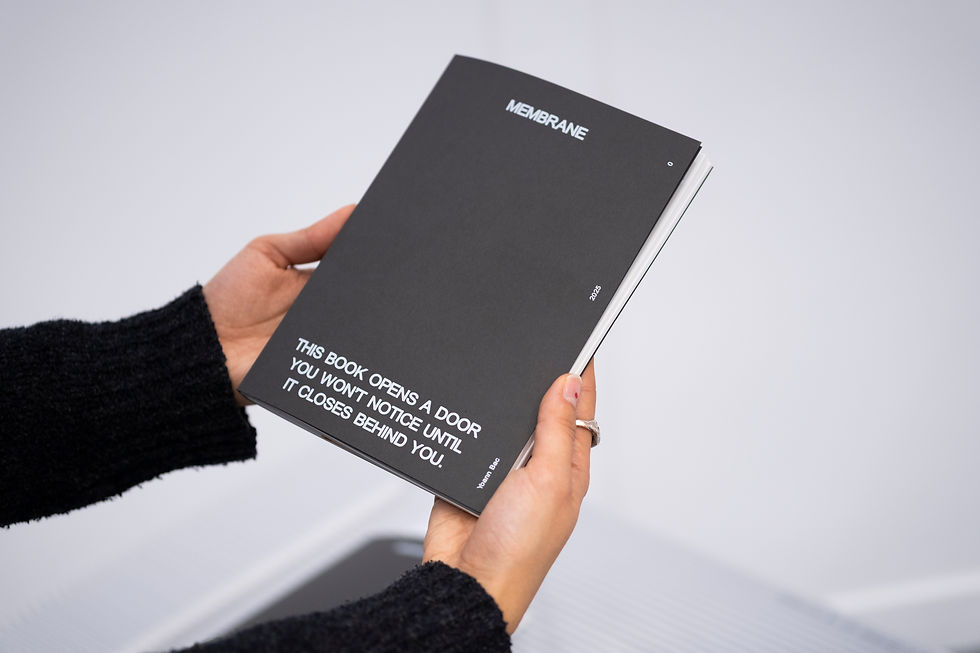
Exhibition view, Membrane, Yoann Bac, Alo Galerie, Paris, 2025. Membrane © Bellise Perrin.