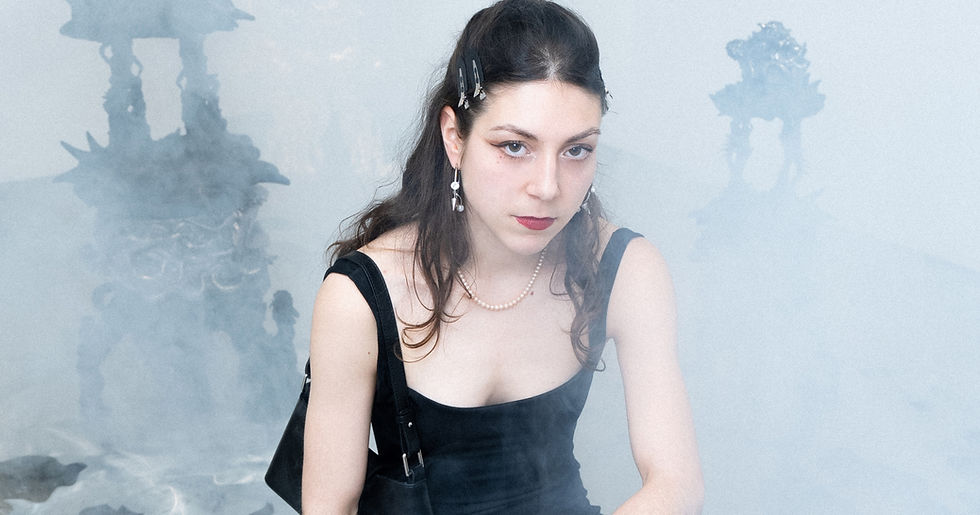
Irmak Dönmez︱Fingers Press and Porcelain Leaks
Updated: Sep 17
Self portrait of Dönmez at the 2024 Neo Feminist Residency, Centre Pompadour, France.
Courtesy of the artist.
Irmak Dönmez is a Turkish artist whose sculptural and ceramic pieces engage with corporeal politics. In her practice, Dönmez’s works operate with acute attention to anatomical, psychological, and epistemological structures. They interrupt the inherent dissociation one has between consciousness and the body. Organs and bodily fragments are then reorganized and hybridized from their natural states: bleeding oysters, plants intertwined with flesh, queer mermaid figures. Through these forms, her practice confronts the classificatory logics of gender, phenomenology, and medical pathology.
As Dönmez exhibits the female body as volatile and materially open, the weight of her works is particularly charged within a visual field we come across in our culture today. The digital surge of traditional femininity and idealized wifehood often emerges in parallel with far-right online commentators who argue for domesticity, motherhood, and patriarchal family structures as stabilizing answers to an observed cultural decline. These narratives function within the transnational nexus of ideological rhetoric instead of isolated contexts. In Turkey, for example, gender, reproduction, and conservative values of family have long been central areas of governance. Conservative family discourse and demographic anxieties require the female body as a proxy for national continuity as per moral order.
Against this backdrop, posthumanist and anthropocentric theories provide a framework for reading Dönmez’s reworking of the body beyond its instrumentalization within dominant ideological narratives. Thinkers such as Rosi Braidotti and Donna Haraway conceptualize subjectivity as distributed, interdependent, and entangled across living systems. Dönmez materializes these propositions through hybrid morphologies and bodily distortions. In Garden of Eden (2021), Dönmez refigures Eve as a desiring and autonomous figure pictured in a speculative environment in contact with ecological and multispecies relations. She is no longer a fixed moral allegory; Dönmez’s narrative offers us a life of Eve that precedes the theological script and culpability assigned to her. The entanglement of vegetal and bodily matter unsettles the binary relationship between nature and subject. This destabilization enables a kinship grounded in ecology, rather than genealogy, and shifts our human understanding of identity as premised on bloodline. Hence, roles of care and responsibility becomes redistributed within a multispecies field.
Eating Momy, 2024. Porcelain. © Gülbin Eriş.
If you had to describe the central tension driving your practice right now, what would it be?
The central tension currently guiding my practice lies in the body functioning both as a site of representation and as a mechanism of control. On one hand, the body opens up a space shaped by desire, pleasure, and productivity; on the other, it is a structure constantly regulated, classified, and disciplined by normative systems.
The positioning of the female body in particular as a perpetual mechanism of production and consumption intensifies this tension. My works emerge precisely from the friction between these two conditions. I approach the body not as a fixed identity, but as a state of becoming that is continuously fragmented, leaking, and reconstituted.
Through material, I reveal the internal leakages of my own body and my experience of being positioned as a woman, transforming this experience into a field of inquiry that is both personal and political.
You recently participated in a 4 month residency at the Cerámica Suro residency in Guadalajara, Mexico. How does this change of environments recalibrate the political charge of your work? Do your sculptures absorb local conditions, or do they operate within a more transnational logic?
My works do not produce direct local representations, yet they are not detached from local contexts either. I am primarily interested in mechanisms of control that recur across different geographies, particularly the structures of power built around the body, reproduction, and care.
The issues I engage with and critically address as a feminist continue to surface in strikingly similar ways across diverse cultural contexts. For this reason, my works operate less within a single geography and more on a transnational plane.
Traveling to different places allows me to see the local variations of these structures and their broader commonalities with greater clarity. Through this movement, I bring my own modes of perception and production into the places I inhabit, allowing these encounters to seep into the work.
1. Oysters Making Love, 2023. Porcelain. © Gülbin Eriş. 2. If You Fear the Dark at Night We’ll Burn the City Down, 2025. Porcelain. © Zeynep Fırat. 3. Milk Islands, 2024. Porcelain. © Gülbin Eriş.
Your sculptures often hybridize flesh, plant, and marine forms. Did the geographic and ecological context of Guadalajara shape the morphologies that emerged during your residency?
It was my first time being in such a warm and tropical geography. After arriving in Mexico, I felt that life followed a more go-with-the-flow rhythm, and over time I adapted to it. There is a distinct “Mexican way,” a “Mexican time” in everything, a rhythm where the need to control recedes.
The relationship between nature and the city was also striking. Walking down the street, you see tree roots breaking through concrete sidewalks as they spread. Plants do not withdraw or hide; on the contrary, they exist almost in defiance of the urban order. Trees covered in thick thorns, surfaces that are highly protective yet at the same time provocative… Nature presents itself without being suppressed, exactly as it is.
After this experience, the vegetal forms and sense of organic expansion in my work became more uncontrolled and more pronounced. This was less about imitating nature and more about thinking in the same flow as it. Before going, I had too many plans in mind about what I should do. Once I arrived, I stopped thinking and allowed the work to emerge on its own.
Human Milk for Cows II, 2026. © Gülbin Eriş.
In your work, the female body appears fluid rather than fixed. How do you relate this instability to the highly curated circulation of femininity across digital culture?
Within digital culture, femininity circulates as a highly controlled and curated image. Systems of validation driven by visibility, approval, and algorithmic trends constantly reproduce which bodies and behaviors are deemed acceptable.
In my work, the body occupies a position in direct opposition to this logic. It is open, leaking, anti-Oedipal, and resistant to control. It refuses coherence and compliance. This fluidity creates a site of resistance against the idealized construction of femininity.
I am particularly interested in dismantling the expectations imposed on the female body, especially those shaped through notions of naivety, motherhood, care, and the demand to remain orderly and compliant. Enabling the body to overflow, to generate discomfort, and to exceed normative frameworks becomes, for me, a political gesture.
1. Mermaid’s Milk, 2022. Porcelain. Courtesy of the artist. 2. Filthy Crown, 2023. Porcelain.
© C. Batur Gökçeer.
Your work proposes a form of kinship grounded in ecology rather than genealogy. How do you envision care and responsibility functioning within this multispecies framework?
I think of care and kinship not as relationships that exist only between humans, but as forms of interdependence between materials, bodies, and living systems. Rather than a human-centered understanding of care, I am interested in a space where bodies, plants, other life forms, and even materials touch, transform, consume, and give birth to one another. This is an immanent system that largely operates beyond perception, however, most people tend to live only in connection with other humans.
This approach directly reflects my way of working. The things I care for most, the ones I form a maternal bond with, are my sculptures. The process of working with ceramics is, for me, very close to the experience of birth. It requires constant attention, keeping the material moist, carefully controlling its drying stages, and handling it with extreme sensitivity. If you neglect the material, it breaks—both emotionally and in a very literal, physical sense, cracking and fragmenting. This state of collapse makes the absence of care immediately visible and confronts me with my own sense of motherhood.
During firing, I hand over the works to my kiln, which I think of as a kind of womb. My kiln is called Judith, a reference to both Judith Butler and the story of Judith and Holofernes. From this point, the process is beyond my control. Judith the kiln sometimes destroys everything, sometimes transforms the form, sometimes alters the colors unexpectedly.
I view this process as a shared act of birth between myself and the material. Care and responsibility emerge within this relational, unpredictable, and distributed space.
Folded Fates series, 2025. Porcelain. © Zeynep Fırat.
As your practice evolves, do you see ceramics remaining central, or are you drawn toward other materials that might extend your investigation of hybridity and embodiment?
Actually, I am a painter. Even though my practice has shifted toward ceramics, I still conceive all my ideas as paintings. I see what I produce as three-dimensional paintings.
Working with ceramics has transformed me greatly. The production process is vigorously anxiety-inducing; many times, works I poured labor into ended up ruined. You get used to the collapse. Ceramics is a material that constantly reminds you control is not yours.
Since I didn’t study in a ceramics program, I love playing around with the “rules” of the medium, disregarding mistakes, and blending it with other materials. I want to experiment with combining ready-made and unconventional materials. If nothing new is happening, that becomes incredibly boring for me. For my solo exhibition, I’m planning a structure made out of painting, drawing, and various three-dimensional materials.
Beyond ceramics, I have grown attached to porcelain. Its bourgeois, white, smooth appearance hides the most fickle and fragile clay in the world. Producing provocative works with such an aesthetic and politically charged material creates a duality that I enjoy—I love this contextual convolution.
What things are you most looking forward to for the rest of 2026?
I’m excited about new experiments. I have a long list of creative ideas, and I keep opening it up to mull over how I relate things to each other and what I think about each connection.
This year, I’ll be preparing for my solo exhibition in Turkey, so I’m trying to get into that mindset. The idea of having the entire space to myself has been intense, which is why I had been avoiding it for a while, but now I feel ready to surrender to it.
In October, I’ll participate in a group exhibition at Helmut Space in Leipzig, which I’m very much looking forward to. I will be displaying new works for this project. Additionally, my series Human Milk II for the Cows will be on view at Ci Bloom in collaboration with Martch Art Project starting April 15.
Courtesy of the artist.